

Can I Register New Vehicle In Different State If I'm Getting Ready To Move There

A figure illustrating the vehicle routing problem
The vehicle routing trouble (VRP) is a combinatorial optimization and integer programming trouble which asks "What is the optimal set up of routes for a fleet of vehicles to traverse in order to deliver to a given set of customers?". It generalises the well-known travelling salesman problem (TSP). It first appeared in a paper by George Dantzig and John Ramser in 1959,[i] in which the beginning algorithmic approach was written and was applied to petrol deliveries. Often, the context is that of delivering appurtenances located at a key depot to customers who take placed orders for such goods. The objective of the VRP is to minimize the total road toll. In 1964, Clarke and Wright improved on Dantzig and Ramser'south approach using an effective greedy algorithm called the savings algorithm.
Determining the optimal solution to VRP is NP-hard,[2] then the size of problems that tin can be solved, optimally, using mathematical programming or combinatorial optimization may be limited. Therefore, commercial solvers tend to use heuristics due to the size and frequency of real world VRPs they need to solve.
The VRP has many direct applications in industry. In fact, the utilize of computer optimization programs tin can requite savings of 5% to a visitor[3] as transportation is commonly a significant component of the cost of a product (10%)[four] - indeed, the transportation sector makes up x% of the EU's Gross domestic product. Consequently, whatsoever savings created by the VRP, even less than 5%, are significant.[3]
Setting up the problem [edit]
The VRP concerns the service of a commitment company. How things are delivered from one or more than depots which has a given ready of home vehicles and operated by a set of drivers who tin can motion on a given route network to a set of customers. Information technology asks for a determination of a set up of routes, S, (one route for each vehicle that must start and finish at its own depot) such that all customers' requirements and operational constraints are satisfied and the global transportation price is minimized. This cost may be monetary, distance or otherwise.[2]
The route network tin can be described using a graph where the arcs are roads and vertices are junctions betwixt them. The arcs may be directed or undirected due to the possible presence of one way streets or dissimilar costs in each direction. Each arc has an associated price which is more often than not its length or travel time which may be dependent on vehicle type.[2]
To know the global cost of each road, the travel cost and the travel fourth dimension betwixt each customer and the depot must be known. To do this our original graph is transformed into i where the vertices are the customers and depot, and the arcs are the roads betwixt them. The cost on each arc is the lowest cost between the two points on the original road network. This is easy to do equally shortest path problems are relatively easy to solve. This transforms the sparse original graph into a complete graph. For each pair of vertices i and j, there exists an arc (i,j) of the complete graph whose cost is written as and is divers to be the toll of shortest path from i to j. The travel fourth dimension is the sum of the travel times of the arcs on the shortest path from i to j on the original road graph.


Sometimes it is impossible to satisfy all of a customer's demands and in such cases solvers may reduce some customers' demands or leave some customers unserved. To bargain with these situations a priority variable for each client can be introduced or associated penalties for the partial or lack of service for each client given [ii]
The objective function of a VRP can be very different depending on the item application of the result just a few of the more common objectives are:[2]
- Minimize the global transportation cost based on the global distance travelled too as the fixed costs associated with the used vehicles and drivers
- Minimize the number of vehicles needed to serve all customers
- Least variation in travel fourth dimension and vehicle load
- Minimize penalties for low quality service
- Maximize a collected profit/score.
VRP variants [edit]

A map showing the relationship between mutual VRP subproblems.
Several variations and specializations of the vehicle routing problem exist:
- Vehicle Routing Problem with Profits (VRPP): A maximization problem where information technology is not mandatory to visit all customers. The aim is to visit in one case customers maximizing the sum of nerveless profits while respecting a vehicle time limit. Vehicles are required to first and stop at the depot. Among the most known and studied VRPP, nosotros cite:
- The Team Orienteering Trouble (Tiptop) which is the most studied variant of the VRPP,[v] [6] [7]
- The Capacitated Team Orienteering Problem (CTOP),
- The Elevation with Time Windows (TOPTW).
- Vehicle Routing Problem with Pickup and Delivery (VRPPD): A number of goods need to be moved from sure pickup locations to other delivery locations. The goal is to find optimal routes for a fleet of vehicles to visit the pickup and drop-off locations.
- Vehicle Routing Problem with LIFO: Similar to the VRPPD, except an additional restriction is placed on the loading of the vehicles: at any delivery location, the item being delivered must exist the item most recently picked up. This scheme reduces the loading and unloading times at delivery locations considering there is no need to temporarily unload items other than the ones that should be dropped off.
- Vehicle Routing Trouble with Time Windows (VRPTW): The delivery locations have time windows inside which the deliveries (or visits) must exist fabricated.
- Capacitated Vehicle Routing Problem: CVRP or CVRPTW. The vehicles accept a express carrying capacity of the goods that must be delivered.
- Vehicle Routing Problem with Multiple Trips (VRPMT): The vehicles tin practise more than one route.
- Open Vehicle Routing Problem (OVRP): Vehicles are not required to return to the depot.
- Inventory Routing Problem (IRP): Vehicles are responsible for satisfying the demands in each delivery point [eight]
- Multi-Depot Vehicle Routing Problem (MDVRP): Multiple depots exist from which vehicles tin can first and cease.[9]
Several software vendors have congenital software products to solve diverse VRP problems. Numerous manufactures are bachelor for more than particular on their research and results.
Although VRP is related to the Job Shop Scheduling Trouble, the two problems are typically solved using different techniques.[x]
Exact solution methods [edit]
In that location are three main different approaches to modelling the VRP
- Vehicle menstruation formulations—this uses integer variables associated with each arc that count the number of times that the border is traversed by a vehicle. It is generally used for basic VRPs. This is skilful for cases where the solution cost can be expressed every bit the sum of any costs associated with the arcs. However it can't be used to handle many applied applications.[2]
- Commodity flow formulations—additional integer variables are associated with the arcs or edges which represent the flow of commodities along the paths travelled by the vehicles. This has only recently been used to find an exact solution.[2]
- Set sectionalization problem—These accept an exponential number of binary variables which are each associated with a different feasible circuit. The VRP is so instead formulated as a set partitioning problem which asks what is the drove of circuits with minimum toll that satisfy the VRP constraints. This allows for very general route costs.[ii]
Vehicle flow formulations [edit]
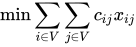
The formulation of the TSP past Dantzig, Fulkerson and Johnson was extended to create the two index vehicle menstruation formulations for the VRP
subject to
-
(i)
-
(ii)
-
(iii)

-
(four)

-
(5)

-
(6)

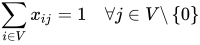
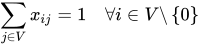
In this conception represents the cost of going from node to node , is a binary variable that has value if the arc going from to is considered as function of the solution and otherwise, is the number of available vehicles and corresponds to the minimum number of vehicles needed to serve set . We are likewise assuming that is the depot node.


Constraints 1 and 2 state that exactly i arc enters and exactly one leaves each vertex associated with a customer, respectively. Constraints 3 and iv say that the number of vehicles leaving the depot is the same as the number inbound. Constraints v are the capacity cut constraints, which impose that the routes must be continued and that the need on each route must not exceed the vehicle chapters. Finally, constraints 6 are the integrality constraints.[2]
One capricious constraint among the constraints is really unsaid by the remaining ones so it can be removed. Each cutting defined by a customer set up is crossed past a number of arcs not smaller than (minimum number of vehicles needed to serve set ).[2]


An alternative formulation may exist obtained by transforming the chapters cut constraints into generalised subtour elimination constraints (GSECs).
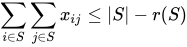
which imposes that at least arcs get out each customer set .[2]
GCECs and CCCs have an exponential number of constraints then it is practically impossible to solve the linear relaxation. A possible fashion to solve this is to consider a limited subset of these constraints and add the balance if needed.
A dissimilar method again is to use a family unit of constraints which have a polynomial cardinality which are known equally the MTZ constraints, they were first proposed for the TSP [eleven] and subsequently extended by Christofides, Mingozzi and Toth.[12]


where is an additional continuous variable which represents the load left in the vehicle after visiting customer and is the demand of customer . These impose both the connectivity and the capacity requirements. When constraint then is not binding' since and whereas they impose that .
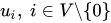


These have been used extensively to model the bones VRP (CVRP) and the VRPB. Nevertheless, their power is express to these simple problems. They can only be used when the toll of the solution can be expressed as the sum of the costs of the arc costs. We cannot too know which vehicle traverses each arc. Hence we cannot use this for more complex models where the cost and or feasibility is dependent on the order of the customers or the vehicles used.[2]
Manual versus automatic optimum routing [edit]
There are many methods to solve vehicle routing problems manually. For example, optimum routing is a big efficiency issue for forklifts in large warehouses. Some of the manual methods to decide upon the nearly efficient route are: Largest gap, S-shape, Aisle-past-aisle, Combined and Combined +. While Combined + method is the nearly complex, thus the hardest to be used by lift truck operators, information technology is the most efficient routing method. Even so the pct departure between the transmission optimum routing method and the real optimum road was on average thirteen%.[13] [14]
Metaheuristic [edit]
Due to the difficulty of solving to optimality large-scale instances of vehicle routing issues, a significant research endeavour has been dedicated to metaheuristics such as Genetic algorithms, Tabu search, Simulated annealing and Adaptive Large Neighborhood Search (ALNS). Some of the most recent and efficient metaheuristics for vehicle routing problems reach solutions within 0.5% or ane% of the optimum for trouble instances counting hundreds or thousands of delivery points .[15] These methods are likewise more robust in the sense that they can exist more easily adjusted to bargain with a variety of side constraints. As such, the awarding of metaheuristic techniques is oft preferred for large-calibration applications with complicating constraints and decision sets.
See also [edit]
- Chinese postman problem
- Vehicle rescheduling problem
- Arc routing
References [edit]
- ^ Dantzig, George Bernard; Ramser, John Hubert (Oct 1959). "The Truck Dispatching Problem" (PDF). Direction Scientific discipline. 6 (i): 80–91. doi:10.1287/mnsc.six.1.eighty.
- ^ a b c d eastward f g h i j k fifty Toth, P.; Vigo, D., eds. (2002). The Vehicle Routing Problem. Monographs on Discrete Mathematics and Applications. Vol. nine. Philadelphia: Guild for Industrial and Applied Mathematics. ISBN0-89871-579-2.
- ^ a b Geir Hasle; Knut-Andreas Lie; Ewald Quak, eds. (2007). Geometric Modelling, Numerical Simulation, and Optimization:: Applied Mathematics at SINTEF. Berlin: Springer Verlag. ISBN978-3-540-68783-2.
- ^ Comtois, Claude; Slack, Brian; Rodrigue, Jean-Paul (2013). The geography of transport systems (3rd ed.). London: Routledge, Taylor & Francis Group. ISBN978-0-415-82254-i.
- ^ Chao, I-Ming; Golden, Bruce L; Wasil, Edward A (1996). "The Team Orienteering Problem". European Journal of Operational Enquiry. 88 (3): 464–474. doi:x.1016/0377-2217(94)00289-4.
- ^ Archetti, C.; Sperenza, One thousand.; Vigo, D. (2014). "Vehicle routing problems with profits". In Toth, P.; Vigo, D. (eds.). Vehicle Routing: Issues, Methods, and Applications (2nd ed.). pp. 273–297. doi:10.1137/ane.9781611973594.ch10.
- ^ Hammami, Farouk; Rekik, Monia; Coelho, Leandro C. (2020). "A hybrid adaptive large neighborhood search heuristic for the team orienteering problem". Computers & Operations Enquiry. 123: 105034. doi:10.1016/j.cor.2020.105034.
- ^ Ekici, Ali; Özener, Okan Örsan; Kuyzu, Gültekin (November 2015). "Cyclic Commitment Schedules for an Inventory Routing Trouble". Transportation Science. 49 (4): 817–829. doi:10.1287/trsc.2014.0538.
- ^ Mahmud, Nafix; Haque, Dr.. Mokammel (February 2019). Solving Multiple Depot Vehicle Routing Problem (MDVRP) using Genetic Algorithm. 2019 International Conference on Electric, Computer and Communication Engineering science (ECCE). doi:10.1109/ECACE.2019.8679429.
- ^ Brook, J.C.; Prosser, P.; Selensky, Due east. (2003). "Vehicle routing and job shop scheduling: What's the difference?" (PDF). Proceedings of the 13th International Conference on Artificial Intelligence Planning and Scheduling.
- ^ Miller, C. E.; Tucker, E. W.; Zemlin, R. A. (1960). "Integer Programming Formulations and Travelling Salesman Issues". J. ACM. seven: 326–329. doi:10.1145/321043.321046. S2CID 2984845.
- ^ Christofides, Due north.; Mingozzi, A.; Toth, P. (1979). The Vehicle Routing Problem. Chichester, United kingdom of great britain and northern ireland: Wiley. pp. 315–338.
- ^ "Why Is Manual Warehouse Optimum Routing And then Inefficient?". Locatible.com. 2016-09-26. Retrieved 2016-09-26 .
- ^ Roodbergen, Kees Jan (2001). "Routing methods for warehouses with multiple cross aisles" (PDF). roodbergen.com . Retrieved 2016-09-26 .
- ^ Vidal T, Crainic TG, Gendreau M, Prins C (2014). "A unified solution framework for multi-attribute vehicle routing issues". European Journal of Operational Research. 234 (iii): 658–673. doi:10.1016/j.ejor.2013.09.045.
Further reading [edit]
- Oliveira, H.C.B.de; Vasconcelos, G.C. (2008). "A hybrid search method for the vehicle routing problem with time windows". Annals of Operations Research. 180: 125–144. doi:10.1007/s10479-008-0487-y. S2CID 32406011.
- Frazzoli, E.; Bullo, F. (2004). "Decentralized algorithms for vehicle routing in a stochastic fourth dimension-varying environment". 2004 43rd IEEE Conference on Determination and Control (CDC). 43rd IEEE Conference on Decision and Control, 14-17 Dec. 2004, Nassau, Bahamas. Proceedings of the ... IEEE Briefing on Determination & Control. Vol. iv. IEEE. doi:x.1109/CDC.2004.1429220. ISBN0-7803-8682-5. ISSN 0191-2216.
- Psaraftis, H.N. (1988). "Dynamic vehicle routing problems" (PDF). Vehicle Routing: Methods and Studies. 16: 223–248.
- Bertsimas, D.J.; Van Ryzin, G. (1991). "A Stochastic and Dynamic Vehicle Routing Problem in the Euclidean Plane". Operations Research. 39 (4): 601–615. doi:10.1287/opre.39.4.601. hdl:1721.1/2353. JSTOR 171167.
- Vidal T, Crainic TG, Gendreau M, Prins C (2013). "Heuristics for multi-aspect vehicle routing problems: A survey and synthesis". European Journal of Operational Research. 231 (1): 1–21. doi:ten.1016/j.ejor.2013.02.053.
- Hirotaka, Irie; Wongpaisarnsin, Goragot; Terabe, Masayoshi; Miki, Akira; Taguchi, Shinichirou (2019). "Quantum Annealing of Vehicle Routing Problem with Time, Land and Capacity". arXiv:1903.06322 [quant-ph].

Source: https://en.wikipedia.org/wiki/Vehicle_routing_problem
Posted by: keencirse1935.blogspot.com
0 Response to "Can I Register New Vehicle In Different State If I'm Getting Ready To Move There"
Post a Comment